
The latest scare-balloon launched by opponents of LNG in BC: There are going to be hundreds of LNG carriers travelling through BC ocean waters.
Capitalizing on concerns about oil tankers, one opposition group sees future LNG carrier traffic along the southern BC coast as potentially numbering “in the realm of 800+ transits a year.”
Eight hundred transits a year? BC Ferries runs more than 185,000 transits a year — and those ferries don’t have tugs helping them to get safely to and from LNG terminals, and don’t have certified BC Coast Pilots on the bridge to keep progress safe.
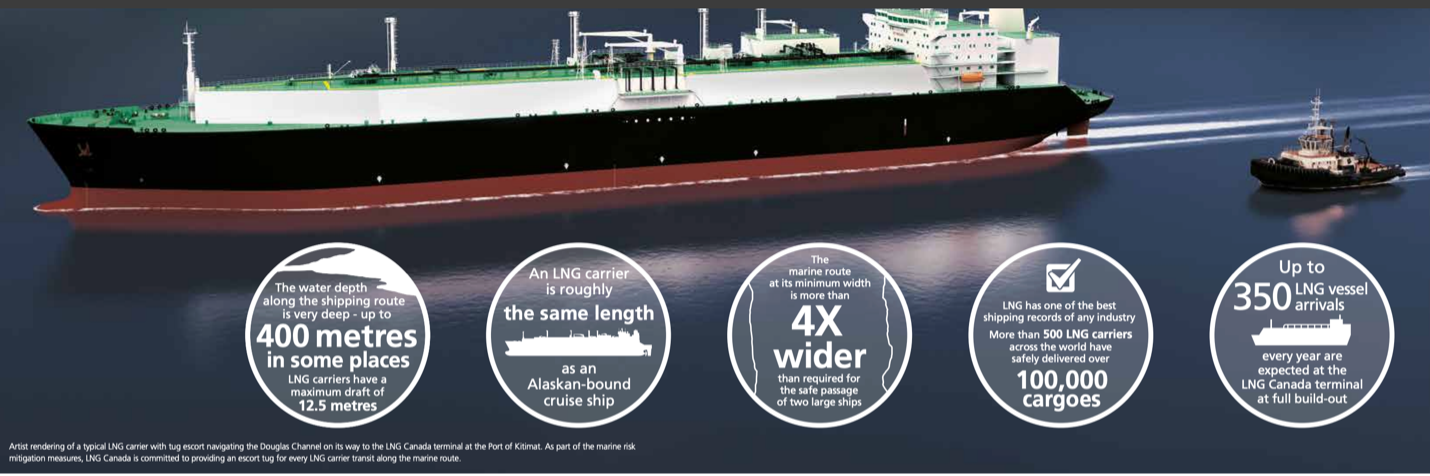
Here’s how LNG Canada speaks to safety at sea for carriers of its export cargoes: “LNG shipping has one of the best records in the shipping industry . . . without a single cargo loss since the first commercial cargo was shipped in 1964.”
And it continues: “We insist on operating within the strictest standards and industry best practices, on land and at sea.
“LNG carriers are designed and built to only transport LNG, and to very high standards. This means every safety measure in place specifically addresses the needs of LNG shipping and environmental protection.
“All LNG carriers adhere to rigorous safety standards and requirements established through years of commercial LNG operations and help ensure the protection of the world’s waterways.”
And:
- “Every LNG carrier that arrives or leaves the port (at Kitimat) has been designed and built to rigorous international standards and independent classification rules, without exception. Ships are re-inspected on a regular schedule and given a full dry dock inspection every five years.”
- “All LNG carriers have double hulls and cryogenic cargo containment systems. The LNG is transported in four or five cryogenic tanks specially designed for LNG, maximizing the ship’s safety and integrity.”
- “Advanced navigational systems include radar, modern global positioning systems, and automatic ship identification systems fitted to ensure ship staff and BC Coast Pilots are fully aware of nearby traffic and navigational hazards.”
The carriers also have built-in cargo-safety monitoring and shutdown systems, and have access to real-time satellite weather routing information that enables them to manage their voyages to avoid the most severe weather.
At its Tilbury operations on the Fraser River, FortisBC notes that: “LNG carriers travelling on the Fraser would be smaller than the car carriers and container ships that currently travel the Fraser River.”
FortisBC also points out that the Fraser River Pilots, an independent association of maritime pilots that specialize in piloting the large foreign ships in the Fraser, says LNG vessels can be moved safely along with other vessel traffic on the Fraser River.
At LNG Canada, marine captain Duncan MacFarlane says: “LNG carriers are some of the most sophisticated ships in the world. . . .
“Once loading operations are complete (at LNG Canada), three BC Pilots will join the ship and start navigating up the Douglas Channel, which is approximately 159 nautical miles out to the Prince Rupert pilot station.
“LNG Canada has partnered with HaiSea Marine, which is a company formed between the Haisla Nation and Vancouver-based SeaSpan, to provide two escort tugs and three harbour-assist tugs to safely move the vessel out of the Douglas Channel.
“Once the vessel drops the pilots at Prince Rupert, it starts a seven- to ten-day voyage to its discharge port. To assist with this, they’ll use satellite navigation, weather routing, and a variety of other technologies to get to their port the safest and most efficient way.”
LNG Canada also says Kitimat is an ideal location for an LNG marine terminal, an active industrial port that offers ice-free, sheltered deep water passage for ocean-going vessels.
“After LNG carriers arrive from Asia, having crossed the Pacific, they make for Triple Island pilot station, approximately 40 kilometres due west of Prince Rupert. . . .
“At a pre-arranged point west of Triple Island, two certified B.C. Coast Pilots with extensive knowledge of the local waterways will board each LNG carrier and provide local area navigational expertise.
“A powerful and purpose-built tugboat will meet the LNG carrier and provide an escort, staying close to the LNG carrier, all the way to and from the terminal. . . .
“Upon arrival in the Port of Kitimat, up to three harbour tugboats will meet each LNG carrier and assist the vessel for the remainder of the journey and onto the berth. To ensure minimal effect on the marine environment and surrounding coastline, the vessels will operate at slower speeds of between 8 and 14 knots subject to navigational safety.”
And LNG Canada adds: “Just before entering the berth, the LNG carrier will be turned around 180 degrees by the harbour tugs, and assisted in stern-first onto the jetty so that the carrier can unberth quickly and head out to sea if necessary.”
- Learn more: https://ow.ly/YmOl50XC113
Our thanks to Resource Works for much of the content of this blog.
(Posted here 10 December 2025)
