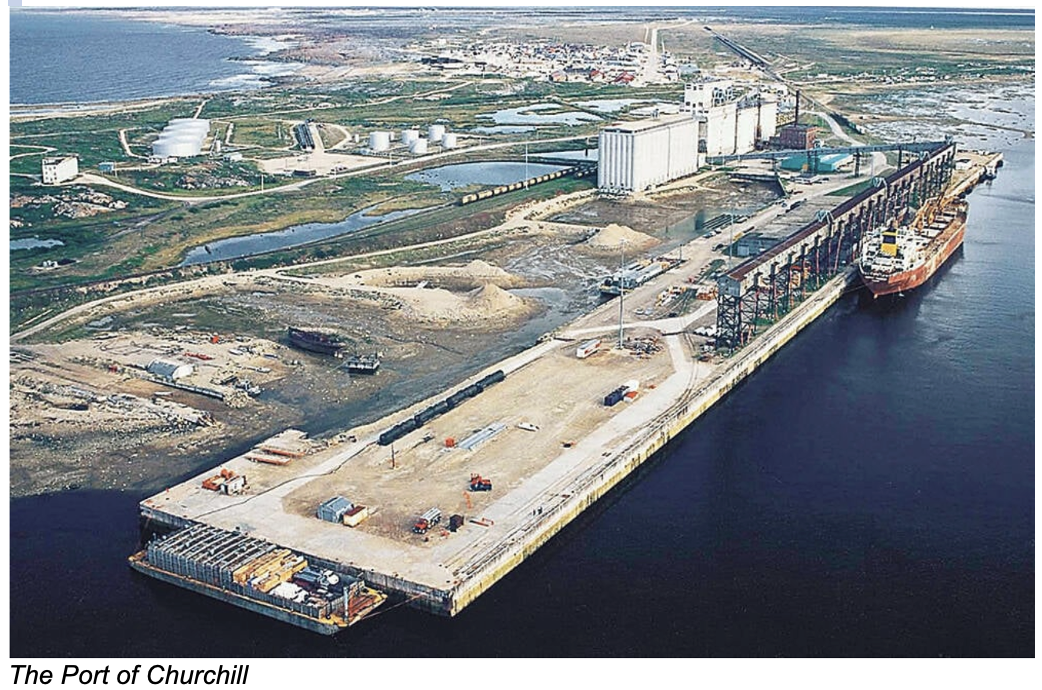
Manitoba is putting up $51 million in new funding to help upgrade the Hudson Bay Railway, as federal and provincial government officials begin work toward the possibility of expanding the Port of Churchill in northern Manitoba.
Arctic Gateway Group, a partnership of Hudson Bay communities and 29 First Nations, owns the port. It says the new money would pay for engineering work required to allow construction on the northern rail line to bring it up to Class I status, which means it could accommodate heavier loads.
The funding will also pay for new storage and loading systems to handle critical minerals, potash, and Arctic supplies at the Port of Churchill as well as additional ships and equipment to handle more marine traffic, Arctic Gateway said.
Manitoba Premier Wab Kinew says expansion at Churchill is a “major priority” for Manitoba.
His vision incudes port expansion, the upgraded Hudson Bay Railway, an all-weather road to Churchill and perhaps other northern Manitoba destinations, the presence of icebreakers in Hudson Bay, and an “energy corridor” that could handle natural gas and LNG, oil, and electricity or hydrogen, the latter most likely in the form of ammonia.
Kinew says that with US President Donald Trump talking of taking over Greenland the need for expansion of Churchill is vital. “What is our only hope if this Greenland stuff continues? Churchill. So we’re leaning into Churchill hard.”
Also from Kinew: “Canada has a lot of great plans for the future, but there’s only one port and one rail line that feeds the Arctic, and that would be absolutely essential for us to maintain sovereignty.”
In November, Kinew’s government said its $51 million for the Arctic Gateway Group brought total provincial investment in the project to $87.5 million, plus $175 million of federal funding.
And Manitoba announced: “Prime Minister Mark Carney and Premier Wab Kinew committed to continuing this work in an expedited fashion, with a view of sharing the strategy and plan for Churchill in spring 2026.
Kinew (himself Indigenous, an Ojibway member) also has set up a Crown-Indigenous partnership to spearhead Churchill expansion.
“Churchill has always been a gateway to the world,” said Kinew. “For generations, people have seen its potential, but what was missing was the partnership to bring it to life.”
Arctic Gateway CEO Chris Avery said the existing town and port at Churchill offer a solid foundation to build on.
“The civic infrastructure (is) designed for about 5,000 people. The population today is less than 1,000, so we have all the infrastructure there from sewage to plumbing to housing and electricity and so on. . . . We have the rail access to the port. We have the grain elevator ready to go in Churchill and we have the port undergoing additional investments for it to be ready to export commodities around the world.”
Federal Northern and Arctic Affairs Minister Rebecca Chartrand agrees that Churchill’s location may be critical should international tensions over Greenland escalate.
“Strategically, it can be the supply chain that’s needed to move goods to the North, whether that’s for military, whether that’s for civilians, whether that’s for businesses. I think strategically Churchill . . . is the gateway to the North.”
Kinew began to push his Churchill project with Prime Minister Mark Carney in person in Winnipeg in November. The premier handed Carney a football (in advance of the Grey Cup game that was played in Winnipeg) and declared: “The ball is in his hands.”
Carney described the Churchill project as large, ambitious and involving many steps. He made no promises.
The “Port of Churchill Plus” project is on the federal Major Projects Office’s “transformative strategies list” but is not on the list of five projects already declared to be of “national importance.” (Those five include expansion in BC of LNG Canada, the launch of Nisga’a Nation’s Ksi Lisims LNG project, and BC Hydro’s North Coast Transmission Line that would power Ksi Lisims LNG and other BC natural-resource ventures.)
While Churchill has historically been blocked by Arctic ice for up to eight months a year, development fans say climate change is keeping sea lanes open longer.
Says Arctic Gateway CEO Chris Avery: “University of Manitoba tells us that (the sea lanes) can — without icebreakers — be open for about six months of the year already, given climate change. They have their findings out already and it’s going through peer review.”
And proponents say a potential new fleet of icebreakers could deal with any ice problems.
Manitoba says the federal government has promised to provide funding to the Arctic Research Foundation to undertake a feasibility study on future deployment and operation of specialized icebreakers, ice tugs and research vessels at the Port of Churchill.
Meanwhile, First Nations leaders in Manitoba have said any development of Churchill must include meaningful partnership and investment in northern communities.
And the Indigenous-owned NeeStaNan Utility Corridor Project says its project would be led by First Nations.
Winnipeg-based NeeStaNan proposes an export terminus at Port Nelson, Manitoba, a never-completed seaport on Hudson Bay, 200 km southeast of Churchill. Port Nelson was abandoned in 1918, in favour of the port at Churchill, which was completed a decade later.
Says NeeStaNan: “Prairie commodities such as potash, natural gas, wheat, and bitumen are landlocked in Western Canada. Current methods of transporting these resources are costly and inefficient, involving transporting resources via rail or pipelines to the west through the Rocky Mountains to reach international markets. . . .
“The NeeStaNan corridor can save time and cost and shave 3,500 to 5,500 kilometres from existing transportation routes to Europe, the US Gulf Coast and South America.”
And for LNG exports, NeeStaNan says of Port Nelson: “From here, shipping routes to Europe are 3,000 km closer than other LNG shipping routes that originate in the US Gulf of Mexico and represent shipping times that are up to a week shorter than traditional LNG shipping from US suppliers.”
Meanwhile, a Saskatoon-based company, Pisim Power, is eyeing development of a multi-corridor project that stretches from the Pacific Coast to Hudson Bay — and wants it to be Indigenous-led and with Indigenous equity participation.
The Pisim Power project would encompass everything from from railways, green energy and pipelines to the potential for new paved roads, said Dan Ukrainetz, Pisim’s vice-president of finance.
“We want to start the conversation between First Nations and the industry and allow for the infrastructure to be built. I think any government would be in favour of seeing the industry and First Nations create the solution and bring to them a final product.”
Ukrainetz says there are around 110 First Nation communities within 25 km of the proposed stretch of corridor project, and the company has had conversations with around 35 Nations so far. Pisim Power says it also in talks with provincial governments in Saskatchewan and Alberta.
Premier Kinew says a “a major energy company” is interested in development of Churchill. He didn’t name the firm, but said:
“At this stage, it’s just really exciting for the province of Manitoba to be able to say that real private-sector investment is starting to come off the sidelines and say, ‘You know what, this Churchill thing is . . . worth us looking at in great depth and detail.’”
And Alberta Premier Danielle Smith, who proposes an oil pipeline from Alberta to BC, said she is also interested in the potential for oil exports via Churchill. “North, south, east, west — we’re willing to go in every direction.”
(Posted here 05 February 2026)
