
The headline from Resource Works said it all: “LNG attacked with myth-information.”
The story went on to address two claims being pushed these days by anti-LNG groups:
- That the world faces a glut of LNG production that will push prices down, thus damaging LNG Canada and endangering the coming Woodfibre LNG and Ksi Lisims LNG projects in BC, and the potential expansion of LNG Canada.
- The oldie that “LNG is bad for the climate” and “LNG emits about as much greenhouse gas as coal.”
On the first issue, there are indeed reports that new LNG output coming online between now and 2029 raise the issue of over-supply, meaning a glut that could depress prices.
But professional market-watchers see lower prices as actually increasing demand.
In its latest outlook, for example, the International Energy Agency (IEA) expects the rate of global supply growth to accelerate in 2026 to more than 7%, its fastest pace since 2019.
However, the IEA adds that any glut-caused price reduction for LNG is set to “incentivize additional demand in price-sensitive consumers, especially in the fast-growing energy markets in Asia.”
Shell CEO Wael Sawan dismisses concerns about a supply glut, saying abundance of gas will instead likely create new pockets of demand in price-sensitive markets.
“Plentiful LNG at the right prices” will likely foster demand in sectors such as road and marine transport, including the trucking sectors in China and India, he said.
LNG shortage seen by 2030
And QatarEnergy’s CEO, Saad al-Kaabi, says that growing electricity demand from AI and data centres, along with rising LNG use in Asia and Europe, could turn the anticipated supply glut into a real shortage by 2030.
“I have no worry at all about demand in the future. I have a worry about the lack of investment for additional supply in the future.”
The IEA agrees, projecting that future global electricity demand, and its need for natural gas, will outpace previous expectations, driven by data centres, cooling, and industrial electrification.
Thus Japan’s oil and gas major, Inpex, expects an LNG shortage in the Pacific coastal region, including Asia, in 2035.
Inpex expects global LNG demand to increase to about 700 million tonnes per year in 2035, up from the current level of some 400 million tonnes.
“Demand will be concentrated in the Asia–Oceania region, accounting for about 60% of the total,” Inpex said in its outlook to 2035.
The Pacific coastal region, including Asia, could see a supply shortfall of 231 million tonnes a year in 2035, according to Inpex.
Here at home, Prime Minister Mark Carney said Canada will export 50 million tonnes per year by 2030, all destined for Asian markets.
His energy minister, Tim Hodgson, then doubled down on that number, speaking of “as much as 100 million tonnes.”
Update: On a visit to India in March, Prime Minister announced the sale of uranium to India, and ‘welcomed India’s intention to source LNG from Canada.’ And he confirmed “Canada’s stated goal of producing 50 million tonnes of LNG per year by 2030 and up to 100 million tonnes by 2040.” https://bit.ly/4raVxu3 and https://bit.ly/4sibbVl
Our BC LNG is ‘clean’
The other myth busted is the old one that our LNG is “dirty.”
Such attacks often cite a US university study whose author insisted that “LNG has a larger greenhouse gas footprint than any other fuel.” He cited “fugitive emissions” — leaks of methane during processing and transportation
But, as Resource Works has noted, that study has been “much and rightly challenged,” and other studies find that LNG really is cleaner than burning coal for power generation.
(By the way, three provinces still burn coal to generate some of their electricity: Saskatchewan, Nova Scotia, and New Brunswick. All say their coal-burning will be slowly phased out.)
Our First Nations Natural Gas Alliance points to a report from the independent Public Policy Forum that says: “Canadian LNG — especially from British Columbia — has a world-leading low life-cycle carbon intensity.”
It notes that a significant portion of global LNG exports is used for electricity generation in importing countries.
“Delivered to China, for example, B.C. LNG is estimated at ~74 kilotonnes (kt) of CO₂e per terawatt hour (TWh) of generated electricity versus ~124 kt/TWh for U.S. LNG —about 40 percent less — implying benefits even when Canadian volumes replace other LNG rather than coal.”
Low emissions for BC LNG
- LNG Canada says its project at Kitimat BC emits less than half the greenhouse gas emissions of the average LNG facility currently in operation.
- Woodfibre LNG aims to be a net-zero emitter by 2027 – 23 years ahead of government net-zero regulation. It also aims to become the first LNG facility in the world to achieve net-zero emissions.
- The Haisla Nation’s Cedar LNG project, which is under construction, says: “Cedar LNG will be one of the lowest carbon intensity LNG facilities in the world. It will contribute to the displacement of coal as an energy source in Asia . . . contributing to lower overall global emissions.”
- And the Nisga’a Nation’s Ksi Lisims LNG project not only promises low emissions but also aims to have net-zero emissions by 2030.
The Intergovernmental Panel on Climate Change (IPCC), the United Nations body for assessing the science related to climate change, says natural-gas power produces 50% fewer emissions than coal power — even when fugitive methane emissions from natural gas are taken into account.
The International Energy Agency says that, globally, on average, LNG results in about 25% less emissions than coal, and that new technology can cut LNG emissions by 60%.
Back to Resource Works: Its founder and CEO, Stewart Muir, describes Canadian LNG exports as a significant climate opportunity, arguing that displacing coal and higher-emission gas in Asia with BC LNG could reduce global emissions by as much as 70 megatonnes annually.
- Stewart Muir video: https://bit.ly/4bYdJDe
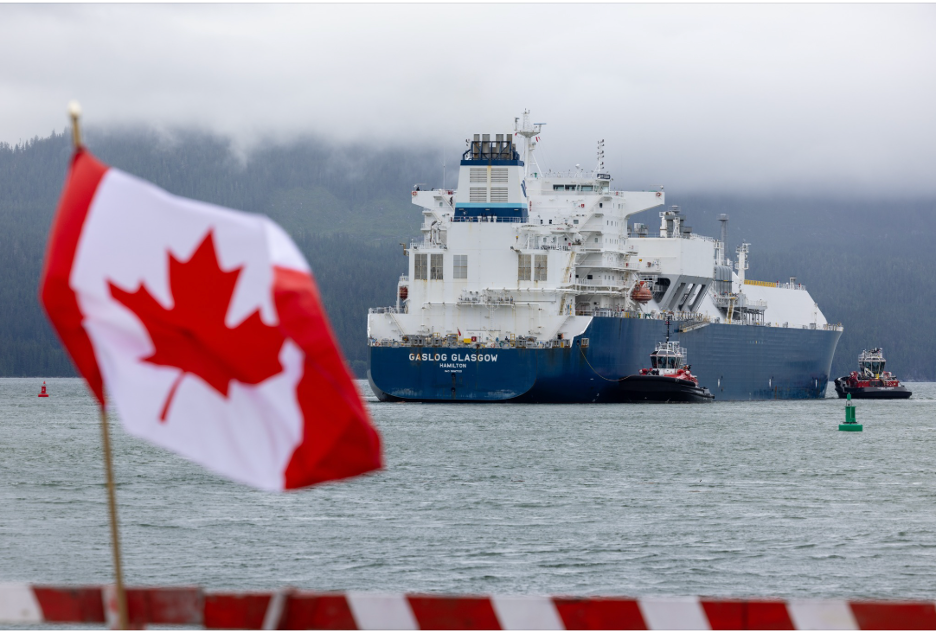
The LNG carrier Gaslog Glasgow, which transported LNG Canada’s first cargo
(Posted here 18 February 2026, and updated 02 March 2026)
