
After 10 years of federal reluctance to push energy exports, the government of Prime Minister Mark Carney has been signalling things will change.
And now comes a new outlook from the Canada Energy Regulator that sees our natural-gas use, driven by LNG exports, growing by 47 per cent by 2050, and perhaps as much as 75 per cent.
The federal agency’s new “scenarios” envisage a future in which:
- Energy demand could be 12 per cent higher by 2050 (although as much as 10 per cent lower if Canada looks for ‘Canada Net-zero’ by improving energy efficiency and adopting more efficient electric technologies).
- Natural-gas production increases in all scenarios, from a record high of 18.3 billion cubic feet a day (Bcf/d) in 2024. Growth could hit as much as 32 Bcf/d in 2050 (up some 75 per cent from 2024). And even in the most optimistic scenarios output could still be around 21 Bcf/d in 2050, up by close to 15 per cent from 2024.
- Crude oil production increases in the near term for all scenarios, with increases of 6.5 per cent to 11 per cent by 2030. Even in the agency’s greenest scenario, oil production goes up by 3.64 per cent.
- Electricity shows the largest percentage increase in demand from 2023 to 2050 ranging from 26 per cent in the lowest scenario to 84 per cent in the Canada Net-zero model.
- Greenhouse gas (GHG) emissions fall throughout the projection period in all scenarios, with reductions ranging from 21 per cent to 35 per cent lower than 2005 levels. (Net emissions reach zero in 2050 in the agency’s Canada Net-zero model, “which is not a projection, but a pre-determined constraint on this scenario.”)
Fossil fuels used for non-combustion purposes (such as petrochemical feedstocks, asphalt, and lubricants) grow in all of the agency’s scenarios.
Fossil fuels used for combustion fall in demand due to shifts towards biofuels and electricity, driven by federal policies. By 2050, some demand for combustion remains, but from processes equipped with carbon-capture or where emissions are offset by other sectors.
Biofuel demand also grows in all of the regulator’s scenarios, and hydrogen becomes a bigger part of the mix.
The regulator’s outlook for LNG exports comes as Prime Minister Mark Carney paints a picture of Canada as a future “superpower” exporter of energy.
Amid that enthusiasm, though, CEO François Poirier of TC Energy says Canada’s process for approving energy projects is still far too slow, despite PM Carney’s efforts to reform it.
Poirier called on Ottawa to offer a six-month timeline to energy companies applying for key permits.
Carney opened the new Major Projects Office last year to accelerate proposals to approval within two years (in the past it has sometimes taken 10-12 years) but Poirier said that’s not competitive in a world where energy demand is rising.
““We’re competing for international customers to deliver them LNG,” said Poirier. “We want to diversify beyond the U.S. We don’t get to pick the timelines.”
He said TC Energy was able to get permits in only seven months for its Southeast Gateway natural-gas pipeline in Mexico, “and I assure you no environmental corners were cut.”
TC Energy transports about 30 per cent of the natural gas in North America. The huge power requirements of data centres mean TC Energy could add billions of dollars of new projects in the U.S. to feed the centres.
But Poirier said: “it’s challenging right now, given the permitting timelines, for infrastructure to be built quickly enough to keep up with the demand growth.”
This story is condensed from a feature by Resource Works at https://bit.ly/4tkqMV4
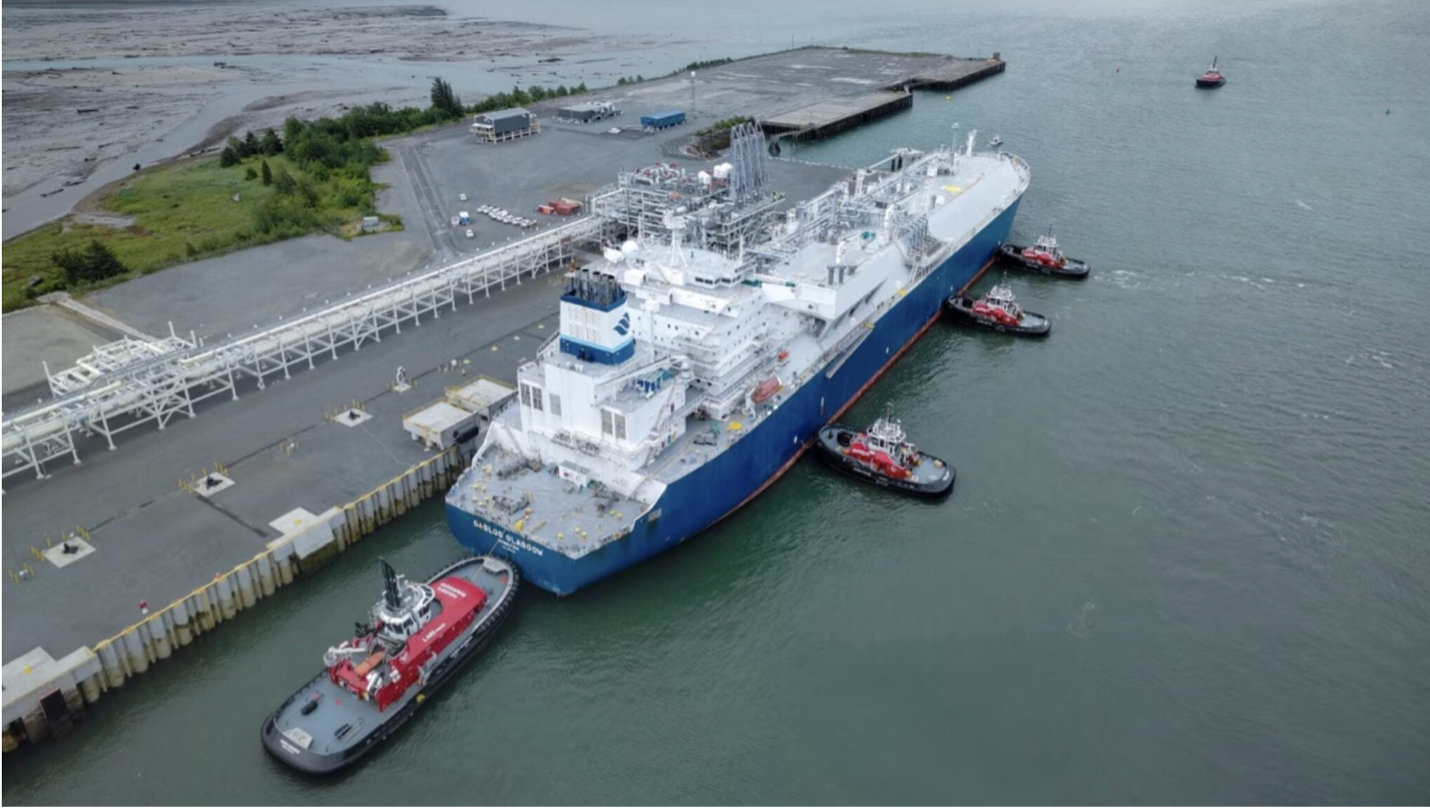
The LNG carrier Gaslog Glasgow at LNG Canada for the first export cargo, which left on June 30, 2025
(Posted here 02 April 2026)
