Ottawa sees Canada as a new energy superpower
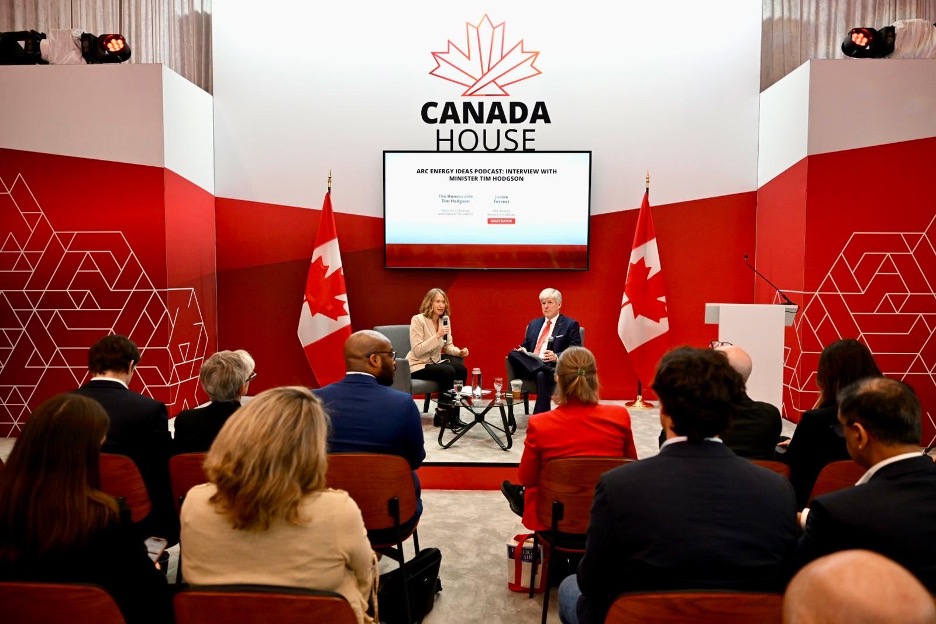
This report is from Arc Energy Institute’s latest podcast, an interview by Jackie Forrest with Tim Hodgson, federal minister of energy and natural resources. Hodgson begins with this:
“I think Canada’s having a moment in the sun. . . . We are in a different world today. We are right now facing one of the biggest energy crises in my lifetime. I’ve got more grey hair than most of you, so probably in your lifetimes.
“The world . . . is going to reorder. We have a whole group of major energy producers in the Middle East who have to figure out how they fit into the world going forward. We have many of our allies who today rely on that region for their supplies who have to figure out what does energy security look like going forward. What does national security look like going forward when the very existence of your ability to survive as an economy is a threat?
“It’s funny how we get lulled into a sense of complacency. What I found when I started going to Europe is the Europeans really understand this issue, that energy security is national security. The war in Ukraine made it very clear to them.
“When I talk to my colleagues from Germany, or from Italy, or from France, or from Poland, they will tell you that they were weeks away from their economy shutting down, that they were weeks away from sending kids home from schools because they couldn’t heat their schools.
“They’ve had a really difficult time adjusting to a world where they can no longer rely on a hegemon for energy security. Just as we were sort of getting comfortable with that, what’s happened in the Middle East has happened and now not only is Europe reminded of what they’ve gone through, but now our allies in Asia are experiencing the same thing. And so everyone is asking the question, ‘What does energy security look like?’
“Well, it looks like having a stable, reliable partner who believes in free trade, who believes in multilateralism, who when they sign a deal with you will honor that deal, who will not use their energy for coercion, but will use it to unify allies.
“I’m reminded of that movie where you’ve got everyone lined up standing at attention and the drill sergeant says, ‘Okay, everyone who’s a reliable energy supplier who will not use their energy for coercion, take one step forward,’ and everyone takes a step back.
“There’s a couple of people standing there. Well, Canada’s standing there.”
- Jackie Forrest asks if Canada should be selling more strongly its ability to provide Canadian energy to Asia, with shorter shipping distances and no geographic pinch points and choke points.
Hodgson: “I don’t think it’s an accident that in LNG Canada One, the only LNG exporter on the West Coast of North America, has participation from Europeans, from Japanese, from Koreans, from Malaysians, from Chinese. They all understand the shipping distances. They all understand the advantage of sourcing LNG off the West Coast.
“I don’t think it’s an accident that when you look at the other facilities that are either under construction or permitted and getting ready to go to construction, which have a clear line of sight to 50 million tonnes per annum, which would make us the fourth-largest LNG producer in the world. I don’t think it’s an accident that many of those facilities are buttressed by multinational energy producers like a BP, like Total, and supported by all the Canadian gas producers.
“It’s certainly not an accident that we have been getting phone calls from all of our allies in Asia. The interesting thing is we’re also getting calls now saying, ‘Hey, you guys have referred Churchill to the Major Projects Office. Are you serious about building LNG out of Churchill? We’re prepared to give you long-term contracts.’ The answer is yes, we’re serious.”
- Jackie Forrest asks if Canada could hit exports of 100 million tonnes of LNG a year, as forecast by Prime Minister Mark Carney.
Hodgson: “We’ve got LNG Canada (Phase) One at 12 million tonnes per annum. We’ve got Cedar (LNG) and Woodfibre (LNG), which are another eight or nine. We have LNG Canada Two referred to the MPO (federal Major Projects Office) and likely to go FID (final investment decision) later this year. . . . That’s another 12 million tonnes per annum.
“We have Ksi Lisims (LNG project) which is at 12 million tonnes per annum. We have Tilbury (LNG from Fortis BC), which is between two and seven million tonnes per annum. The Haisla are very interested in talking about Bish (the potential Bish LNG project), and I know the BC government is supportive of that. I know Woodfibre has ambitions to double and triple the size of their production. We’re well past 50 (million tonnes) just with what we know today.
“Look, we have this incredible resource in the Montney (natural gas region in BC and Alberta) that is the least-drilled major gas play in North America. . . .
“All the American fields are starting to peak and the productivity of each of their wells is starting to go down. The Montney wells are still going up, and they will go up for some considerable period of time. The world has figured that out, and the world is coming to Canada.”
- Forrest raises the question of the Major Projects Office that is commissioned to fast-track projects, but ‘we don’t see shovels in the ground yet.’
Hodgson: “I’d say if you look at the 15 projects we’ve referred to the Major Projects Office, 15 different projects, $126 billion of new investment, we’re doing pretty well. . . . We expect by early 2027, I think, seven to eight of those projects. . . .
“The Prime Minister . . . expects us to attract $500 billion of private-sector investment . . . by the end of the decade. In the seven months since the MPO stood up, we’re at $125-126 billion. I think we’re going to get there. I’m reticent to say that because I know he’s going to raise the target on me, but that’s the level of ambition that we have right now.”
- Forrest asks about Indigenous Peoples and natural-resource projects.
Hodgson: “When I became chair of the company, (Ontario’s) Hydro One had not built a new transmission line in 10 years. Why was that? Because we were fighting with First Nations.
“We said, ‘Let’s change the paradigm. Let’s move Indigenous engagement from a risk factor to a strategic imperative. Let’s take it from an afterthought to before you do anything, before you come to me to talk about a single dollar investment, tell me what your strategy is to make First Nations and Indigenous peoples your partner.’
“What happens when you do that? Well, fast-forward seven years: Hydro One is building more transmission lines in Ontario than any other jurisdiction in North America. Those transmission lines are coming online ahead of schedule and under budget. . . . .
“Why? Because . . . our First Nation partners were beside us saying, ‘How quickly can we build this? Because we’re really looking forward to our equity cheque. These revenues give us sovereignty. These revenues give us our own-source revenues so we’re no longer standing waiting for a distribution from the government. This is empowerment. We want these projects. If you’re not doing these projects to me, but you’re doing these projects with me, I’m a great partner.’ . . .
“And look at what’s happening in LNG. In all of those LNG projects that I talked about, they are being led in partnership with First Nations. That’s a game-changer. That’s why we’re building now. . . . If you work in partnership with First Nations, your projects will get done faster and cheaper.”
The minister went on to say this:
“The prime minister has been very clear. If Canada is going to realize its potential, we need to be an energy superpower. He’s very specific. We need to be a clean and conventional energy superpower. It’s not one or the other, it’s both. . . .
“If we are going to be a superpower, we need to be the best at both. That is our objective. We’re very clear about that. In the MPO, we are very clear. We are going to be best in class in clean energy, whether that’s wind, whether that’s solar, whether that’s grid storage, whether that’s nuclear, and we’re going to be the best we can be in conventional energy.
“We are going to produce the lowest carbon-intensity-emission LNG in the world, and we are going to produce the lowest-carbon-intensity barrels of crude oil that Canadians can produce.
“When we do that, Canadians say, ‘Hey, this is great. We’re helping our allies.’ We’re putting cards in our hands, and we’re generating the revenues that pay for the lifestyle that Canadians want, that pay for the universal healthcare that we have, that pay for the pharmacare that we have, that pay for the dental care that we have, that pay for the subsidized post-secondary education that we have, that pays for the $10-a-day daycare that helps families have two income earners.
“When we show Canadians that we’re doing the right thing and we’re developing our resources the right way, and that’s helping our allies and that’s helping us, Canadians say, ‘Let’s go.’”
- The podcast and full transcript
- See also: Transforming Canada into an energy superpower: Q&A with the minister of energy and natural resources, Tim Hodgson: https://bit.ly/47OghRu From business law firm Torys LLP