The Cedar LNG project marked on June 25 two years since Haisla Nation and partner Pembina Pipeline Corporation of Canada made a positive Final Investment Decision (FID).
It was, said Cedar LNG, the start of “a new era of Indigenous-owned and led energy infrastructure.” The project is majority-owned by the Haisla Nation (50.1%) in partnership with Pembina Pipeline Corporation (49.9%).
And in the two years since that joint FID the project at Kitimat has made much progress: “We’re on track to deliver the world’s first cargo of Indigenous-led LNG by 2028, setting a new standard for how resource development can be done responsibly, and with Indigenous values and traditions at the helm.”
Cedar LNG will be the first floating LNG (FLNG) facility in Canada. At last official estimate, it’s a $4.7-billion project. (We’ve seen unofficial ones running up to $5.5 billion.)
Cedar reports: “Advancement of engineering design has identified the opportunity to increase the project’s permitted liquefaction capacity from the previously approved 400 million standard cubic feet per day (mmcf/d) of natural gas to 500 mmcf/d.”
Some highlights:
- Shortly after the FID, construction began on site preparation and clearing work. The site is some 10 km southwest of Kitimat, on the territory of the Haisla Nation.
- Last summer, the first pipe went into in the ground for the natural-gas line that will feed the Cedar plant. It will run to Cedar from beside the LNG Canada plant at Kitimat.
- Cedar LNG’s gas will come via the Coast GasLink pipeline that feeds Canadian natural gas to LNG Canada. The Haisla, as part of a benefit agreement with the LNG Canada project, negotiated space on Coastal GasLink for its own LNG project.
- Early clearing work also included preparation for the Cedar LNG distribution pipeline, in the road allowance of the Bish Creek Forest Service Road. And some controlled blasting took place in May and June this year at Cedar’s marine terminal area.
- Cedar is also working toward construction of its power transmission line, an 8.5-km long, 287-kilovolt line, to feed power to the floating facility from BC Hydro’s Minette Bay substation. Clearing for the power line began in March and further work, including drilling and blasting and helicopter work, is set to run until November.
- The corridor chosen for the power line includes protection of old forests and marbled-murrelet nesting habitat, reduced effects on ecological communities and wetlands, and shorter access-road requirements.
- Cedar LNG now has added a night shift of workers. “Work will comply with noise requirements – no hauling, blasting, or potential high-noise work will take place during the night shift. Work lights will be used in a manner that ensures activities are completed safely while also respecting the local community.”
- The hull for the project’s floating LNG plan, named megúgu (Haisla for ‘Spirit of the Cedar Tree’) was launched on June 8 by Samsung Heavy Industries of South Korea. It now is working on superstructure to go onto the hull, including plant modules ranging from 2,000 to 7,000 tonnes and cargo tanks.
- Cedar LNG expects to load export cargoes onto some 50 LNG carriers per year. Like LNG Canada, it will follow rigorous procedures to ensure safe passage for the carriers.
- The project also proposes to house some 80 workers on the floating plant, “to ensure a specific number of trained individuals are aboard the vessel at all times, should there be an incident or emergency.”
Construction of Cedar LNG is part of what TD Securities analysts called “a new era for Canadian natural gas” ushered in by LNG Canada.
And Pembina Pipeline said Cedar LNG can help achieve higher prices for Canadian natural gas while enhancing global energy security. Pembina is a leading pipeline service provider that has served North America’s energy industry for more than 70 years.
The Cedar project had long been thought of by leaders of the Haisla Nation. Crystal Smith, former elected chief councillor of the nation, put it this way: “I think the uniqueness of Cedar is that it was Indigenous-owned from the beginning.” She said it had been “in our sight and in our vision” for some 10 years.
Her successor as chief councillor, Maureen Nyce: “Our vision for Cedar LNG was always predicated on being able to source the cleanest power option to ensure our project delivers LNG with the lowest possible carbon footprint. . .
“When Indigenous communities lead projects as owners, as is the case with Cedar LNG, we are able to ensure that these projects are developed in the most environmentally responsible manner, while generating revenues that enable us to protect our way of life and build long-term prosperity.”
Cedar’s LNG will thus have one of the lowest carbon footprints in the world. That led Adrian Dix, BC’s minister of energy and climate solutions, to say: “Cedar LNG is a model for how LNG projects can be developed through innovation and collaboration with First Nations, while also creating good jobs and addressing climate change.”
(For jobs, Cedar LNG expects as many as 500 people will be employed during peak construction periods, and some 100 fulltime when in operation in late 2028.)
The federal government supported the project with a contribution agreement under its Strategic Innovation Fund of up to $200 million. BC added $200 million to connect the project to BC Hydro’s power grid. And Export Development Canada also provided a commercial loan facility of between $400 million and $500 million.
And announcing a new economic agreement with BC, Prime Minister Mark Carney called Cedar LNG “the First Nation-led floating LNG facility that is among the most advanced First Nation-owned energy projects in Canadian history.”
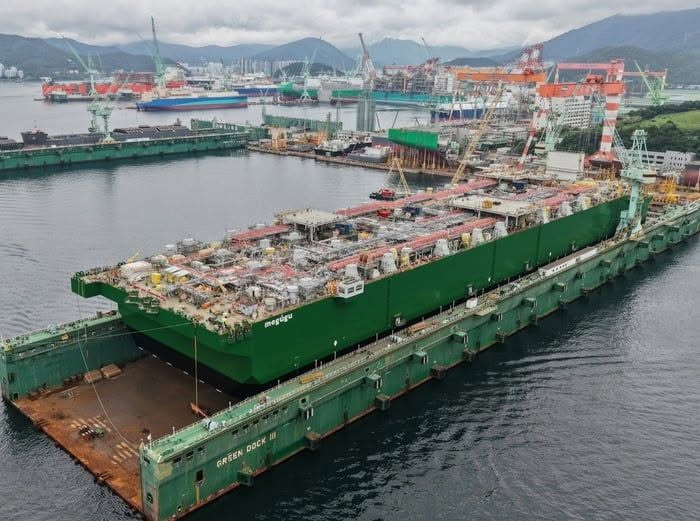
The hull for Cedar LNG’s floating production plant
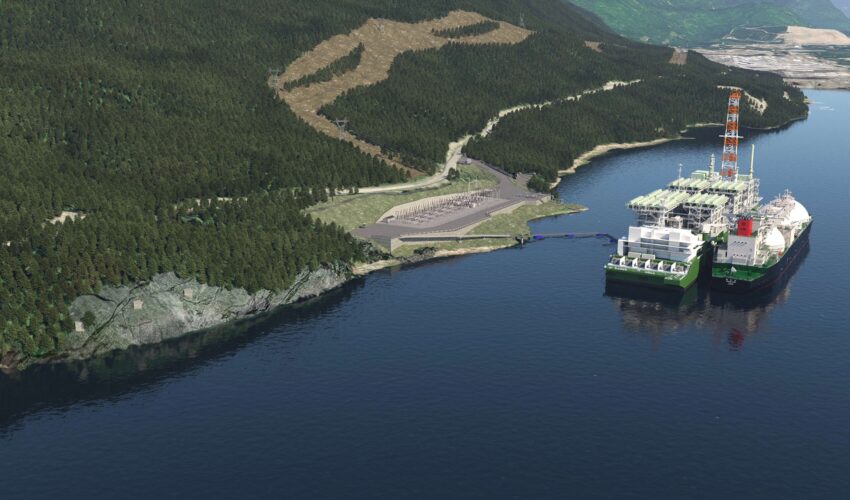
Artist’s concept of the Cedar LNG project in operation
(Published here 09 July 2026)
