
The BC Government lists 35 major projects in BC in various stages of operation or construction or planning. And it says nearly 100,000 job openings are expected across 100 trades in BC over the next decade.
It declares: “There’s never been a better time to get into the trades.”
And the government has promised to add 5,000 trades training seats in every region of BC in 2026-27. “Through the province’s Look West strategy, government is investing $241 million over three years to train more people in BC for in-demand jobs, helping them move onto job sites sooner.”
But for many young people in BC, the opportunities to study and work for Red Seal certification in a hands-on trade present a serious challenge.
Depending on where they live, they could be in for hefty expenses for travel, accommodation and food while they take courses away from home.
Typically, apprenticeship training is spread over four years, with 20% of the time in the classroom and 80% on the worksite under the supervision of a certified journeyperson.
That 80% of time on a worksite means being paid a wage. This usually totals between 4,500 and 8,000 hours, depending on the trade.
But such Red Seal courses and work could also mean out-of-pocket expenses such as travel costs, room and board costing $1,200 to $1,800 a month, or apartment rentals that can hit $2,000 a month plus another $450-$500 for groceries.
Such costs are still a barrier to many students.
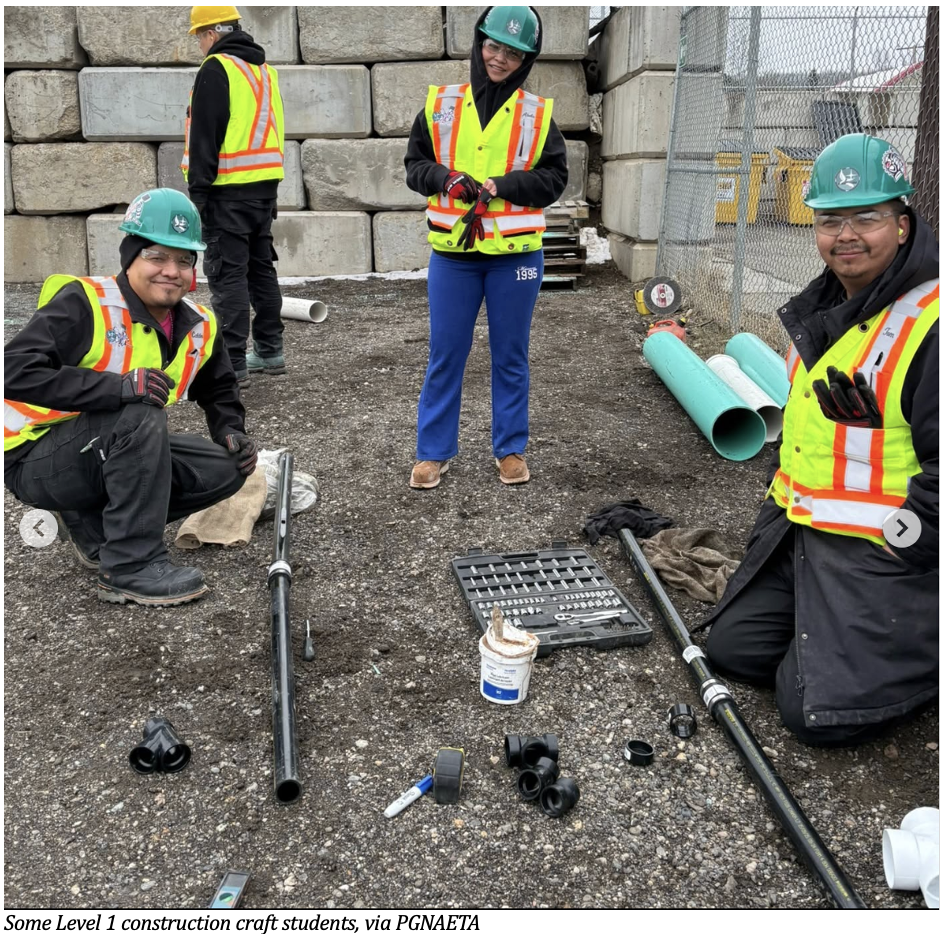
A leader in introductory trades training in BC for Indigenous people is the Prince George Nechako Aboriginal Employment and Training Association (PGNAETA), based at Prince George BC. It’s a non-profit society serving a region that encompasses 17 First Nations Territories.
Its trades program began in 2006. Its introductory program helps 12-14 students at a time, and aims to accommodate three to four such cohorts a year. Those who complete the program become first-year apprentices, and go on to further training.
“We’ve had some wonderful successes,” says PGNAETA executive director Karin Hunt. “Right now we are boasting some 10 First Nations women who now are Red Seal electricians.”
Meanwhile, at Fort St. John and Dawson Creek, the North East Native Advancing Society also offers support with skills training. Right now, for example, it is offering a five-week Land Guardian Program (Sept. 21 – Oct. 23) that leads to Applied Biologist Technician certification.
And at Prince Rupert, the Tribal Resources Investment Corporation has its TRICORP Employment, Skills & Training Services (T.E.S.T.S.) program that links training to labour-market demand: https://bit.ly/3T719KN
Meanwhile, Vancouver Community College (VCC) will receive 224 new skilled-trades training seats as part of the BC government’s aim to deliver 5,000 new seats in 2026-27. VCC thus will have more than 1,770 such seats this year.
At the start, PGNAETA found many students from impoverished First Nations lacked the full level of literacy they’d need to enter a serious trades-foundation program.
“Our main purpose was to get people to the place where they would pass the entrance exams for the trade of their choice, and they get into a foundation program.
“It always came back to our people were ready and willing, but they needed to have pre-trades intervention. We could get some of them to the year-one level, but literacy prevented them from passing exams for year two and three.
“Our Trades Access program now includes trades math and English. It includes all of the preparations that you would need to enter into a trade. And now unions are doing training directly with our young folks. Today, we work in partnership with a good number of the unions.”
One example is LIUNA, the Laborers’ International Union of North America. “LIUNA comes in and does the actual instruction right on the site. When the students write their exam at the end, if they are successful in passing it, they enter in as a first-year apprentice at that point.”
One problem for students from northern BC is that that may have to take further trades courses in the Lower Mainland. “And oftentimes the work you have to do is away from home. It’s out in the camps. It’s out in mining, and so forth.”
Hunt notes that, these days, living accommodation for students can be as costly at Prince George as anywhere in BC. A two-bedroom apartment can easily run to $1,800 a month. Groceries and utilities have gone up by 30%-40%.
“We’ve done a number of different things to try to accommodate that as best we can. We’ve rented Airbnbs so we put all of the students together in one place . . . but the cost is a major issue.
“We normally have two or three different funding agencies involved just to get one cohort through. We’ve had a lot of support from people like FortisBC, and Telus has supported us, and major corporations like that. The unions are very supportive and helpful, too. And so we are able then to be able to provide the supports.”
Hunt points out that students moving to Prince George for PGNAETA training are often leaving a family behind elsewhere in BC.
“Now you’ve got two households that have to be supported. And we are . . . . part of a pilot project in the province where we are able to provide supports to people who are on provincial income assistance and not have them being penalized because of the supports that we provide.”
PGNAETA also has an agreement with Indigenous Services Canada for on-reserve income-assistance recipients. Hunt says PGNAETA can also enable students to remain on unemployment insurance while in training.
“After that, our trades staff work with the different employers and the different unions come in and talk to them, scoping out the ones they want to hire immediately on graduation.
“And then they (the students) still continue to be part of our database of the ready, willing, prepared, qualified, first-year apprentices. So we continue to support them until they get a job.”
Hunt adds: “Our goal is sustainable occupations for our people. We’re not interested in minimum-wage jobs.
“I’m looking at young Indigenous people who are working, and I see that they are just top-notch workers. We’ve had some excellent successes from those young people because they’re eager, they’re bright, they’re wanting to work, they’re very personable, and so on. And now our job is to help them stay at work.”
Hunt adds that PGNAETA us not just helping students in their teens and 20s.
“We’re encouraging people who are in their 30s, 40s and even 50s to look at trades. Based on their life’s experiences, particularly building houses on reserve, for example, can get in at a second-year level or a third-year level.
“The eight-month foundation program is then considered ‘education,’ so the education department of any band can pay for them to be in that program, and pay for their training allowance as well during the program.”
- More on what PGNAETA offers: https://bit.ly/3Sywvd3
(Posted here 03 September 2026 and updated 04 September 2026)
