
If Germany buys LNG from the Ksi Lisims LNG project in BC, as proposed, how would the LNG actually get there?
We have come to see Asia as the prime market for BC’s LNG. And to deliver from Ksi Lisims LNG to Japan’s Sodegaura LNG Terminal on Tokyo Bay, for example, would mean a run of some 3,850 nautical miles for an LNG carrier.
At an average speed of 15 knots, that would be around 10½ days in transit.
If you have to charter your LNG carrier, at around US$45,000 a day (call it $62,000 Canadian) that would mean a charter bill of some US$472,500 (call it $650,000 Canadian) for the voyage.
Getting to Germany is much more costly, and time-consuming.
Going to Germany from Ksi Lisims LNG via the Panama Canal would mean a voyage of more like 9,300 nautical miles, and closer to 26 days.
A 26-day charter of your carrier would run around $1,612,000 Canadian.
Now add the Panama Canal’s fee for a one-way trip, which could be at least $500,000. So your tab to reach Germany could hit $2,112,000.
(And know that the Panama Canal fee has from time to time run into the millions.)
Even that $2,112,000 is cheap compared with going ‘the long way around’ to Germany, circumnavigating the southern tip of South America at Cape Horn.
Now you’d be looking at some 15,500 sea miles, a voyage getting on for much more like 39 days, and a charter cost (assuming you could get a ship for that run) looking much more like $2.5 million at today’s rates.
But we can’t use “today’s rates” for a shipment from Ksi Lisims LNG — which has not yet made a final investment decision and has talked of hoping to start production in 2029.
A cheaper way of getting a shipment of Ksi Lisims LNG to market would be not to sail to to Germany, but to use a “cargo swap.”
As Hodgson told reporters, LNG contracts are typically structured as free on board (FOB), which means the buyer takes possession of the cargo and can send it anywhere.
Thus a Japanese buyer of an LNG cargo from the Middle East could swap that cargo, and have it go to Germany in exchange for an LNG shipment from BC.
“If it’s on a smaller ship, it can flow through the Panama Canal,” Hodgson said. “If it’s a larger ship, it can go around South America or it could go around Africa. Or they could do what’s called a swap. That’s a common practice in global energy markets.”
The buyer of the Ksi Lisims LNG is SEFE, an international energy trader owned by the German government, and free to trade or swap the BC LNG anywhere.
EnergyNow_News, a Canadian source, looked at ‘Getting Canadian LNG to Europe Using LNG ‘Swaps.’ Here’s what it says:
“Liquefied natural gas (LNG) swaps involve agreements where LNG is exchanged between parties in different regions to optimize logistics and reduce transportation costs.
“In the scenario where Canada exports LNG to European countries like Germany via its West Coast, an LNG swap could mean that Canada ships LNG to a country in Asia or the Pacific Rim that is geographically closer, while a partner country with LNG supplies nearer to Europe (such as Qatar, Algeria, or Norway) sends an equivalent volume of LNG to Germany.
“The overall effect is that Canada’s LNG helps meet European demand, but the physical molecules may not travel the entire distance from Canada to Europe.”
EnergyNow News sees advantages for Canada including expanded market access, cost efficiency, environmental benefits (shorter voyages = fewer emissions) and ‘enhancing Canada’s reputation as a reliable energy supplier.’
But it says there can also be disadvantages: intricate contractual arrangements and coordination, potential loss of premium pricing, exposure to geopolitical or market disruptions, and possible impact on Canada’s brand recognition or ability to market its gas as a lower-carbon product relative to competitors.
In the end, we’ll have to await that final investment decision from Ksi Lisims LNG, and the final Sales and Purchase Agreement it negotiates with its German customer.
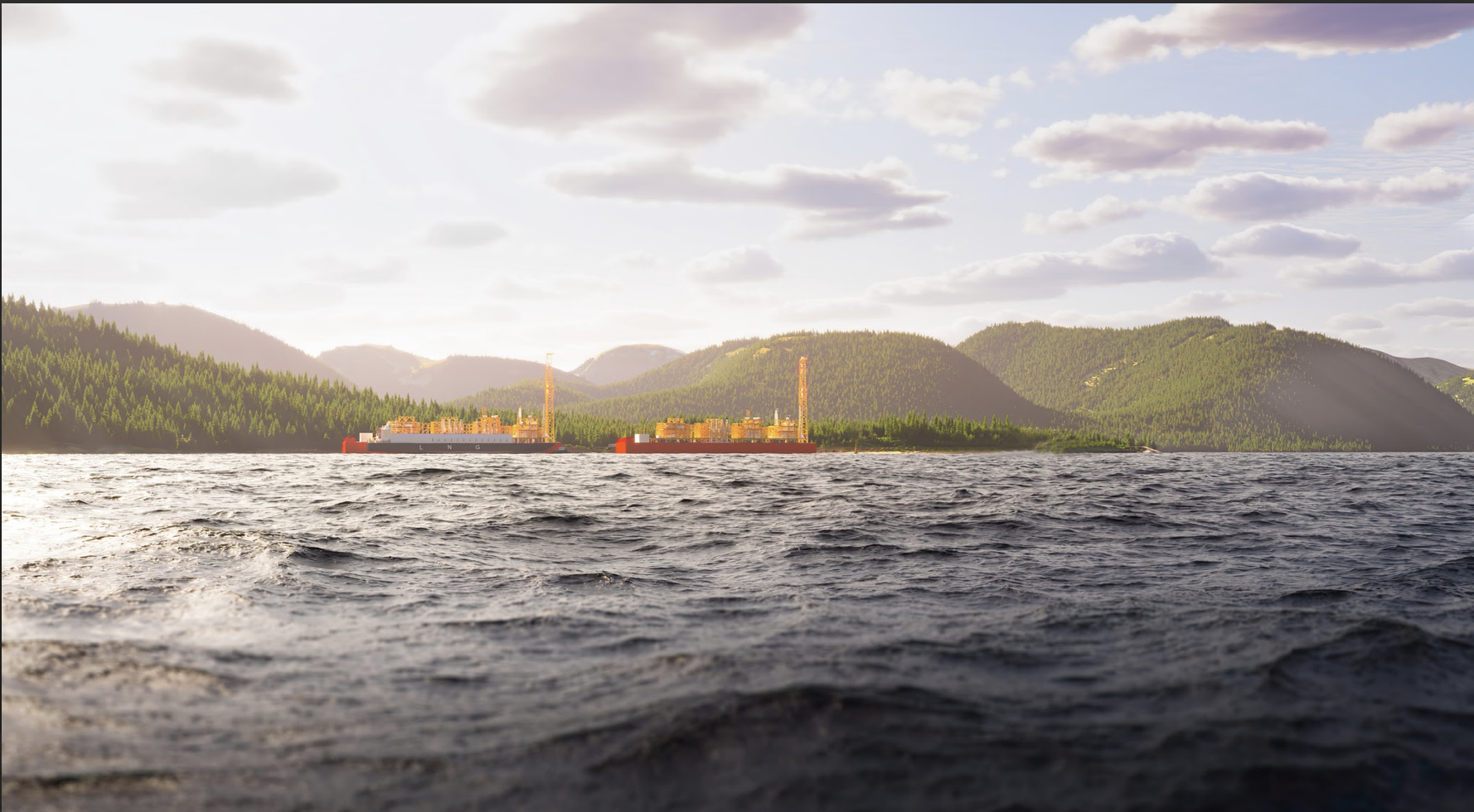
Ksi Lisims LNG: concept
