Squamish Nation supports Woodfibre LNG
A unique agreement makes the nation a project regulator
Woodfibre LNG recognizes the Squamish Nation, Sḵwx̱wú7mesh Úxwumixw, as a partner — and as a full and legal environmental regulator — of the Woodfibre project on Howe Sound in Squamish Territory.
Hereditary chief Ian Campbell, Xalek/Sekyu Siyam, reflects on how all this happened:
“When Woodfibre came along, . . . we opted to exercise a consent-based model, where there was a start and a finish, based on Indigenous science as well as Western science.
“We wanted to really measure a new entrant in the market, such as this export facility, being compatible with our environmental, cultural and spiritual values.
“And that’s what led us to exercise our authority and jurisdiction by conducting our own independent environmental assessment.
“We then issued 25 legally binding conditions which built a solid relationship with our partners.
“You have to build a relationship before you build the project. I think that foundation held true here. I think the foundations that were set live and thrive in the company today. So there is a view of ‘This is how we do business in a good way.’
“Indigenous peoples haven’t been able to participate in previous projects within our territory that are encumbrances that have impacted our economic sovereignty, our food sovereignty, our cultural and spiritual values.”
Recognized as regulator
Woodfibre LNG says it is “incredibly proud to be the first industrial project in Canada to recognize a non-treaty Indigenous government, the Squamish Nation, as a full environmental regulator. . . .
“Taking a collaborative approach to obtain consent on the project resulted in the first-of-its kind Squamish Nation Environmental Assessment Agreement, which includes 25 legally binding conditions for the project. We acknowledge the Squamish Nation as a key partner in our journey.”
Woodfibre LNG is an LNG export facility under construction on the former Woodfibre pulp mill site on Howe Sound, 50 km northwest of Vancouver. It is on the historical location of a Squamish Nation village known as Swiy̓ át.
Says Woodfibre LNG: “Swiy̓ át and Nexwnéwu7ts Átlḵ’a7tsem (Howe Sound) are tied to the cultural well-being of Sḵwx̱wú7mesh Úxwumixw (Squamish Nation) members, their ancestors, and their descendants, and to other Indigenous groups as defined in the project’s provincial Environmental Assessment Certificate and federal Decision Statement.”
The agreement with the Squamish, approved on October 14, 2015, includes 25 conditions applicable to Woodfibre LNG, natural-gas pipeline owner FortisBC, and the BC government.
Company works on conditions
“Woodfibre LNG is responsible for 13 of the conditions identified in the agreement and is actively working with Squamish Nation to ensure that each of these conditions are fully met.”
In June 2015, Squamish Nation issued an independent environmental assessment certificate for the project and for FortisBC’s Eagle Mountain – Woodfibre gas pipeline project – identifying the 25 conditions that must be achieved.
And in October 2015, Woodfibre LNG and the Squamish Nation) signed the Squamish Nation Environmental Assessment Agreement, which “legally commits Woodfibre LNG to constructing and operating the facility in a way that respects Squamish Nation’s cultural values and unique relationship with the lands and marine environment in their traditional territory.”
The company adds: “Maintaining respectful and meaningful partnerships with local First Nations underlies Woodfibre LNG’s approach to developing its net-zero strategy and to constructing and operating the project in a way that will contribute to a resilient community in Squamish and a net-zero future for Canada and the world. . . .
“Woodfibre LNG has worked collaboratively with representatives from local Indigenous communities throughout the environmental assessment process to integrate traditional knowledge and input into the project’s Environmental Management Plans and the design of the facility.
“Woodfibre LNG strives to work with its Indigenous partners to define their level of participation in the project. This includes regular meetings between subject-matter experts, regulatory discussions at various working groups and committees and inclusion of the Squamish Nation in monitoring activities at the project site.”
Woodfibre LNG aims to be the world’s first net-zero LNG facility by 2027, and will produce an estimated 2.1 million tonnes of LNG per year at full build-out.
Nation sparks improvements
In planning for net-zero, Woodfibre LNG says the Squamish Nation environmental-assessment process has led to “many improvements in Woodfibre LNG’s project plans, including the development of two critical facility-design choices that fulfill conditions of the agreement.”
Among the decisions was the commitment for electric compressors. “That eliminates the need for two gas turbines to drive compressor systems and as many as four gas-turbine generator sets for electric power generation. This replaces the need for natural gas and substitutes it with renewable hydroelectricity from BC Hydro.
“The electric drives have the additional benefit of increasing energy efficiency compared to natural gas engines, thereby reducing the overall energy demand. The E-Drive system delivers an emission intensity 14 times lower than conventional liquefaction facilities, resulting in stationary combustion emission reductions of approximately 230,470 tonnes of carbon-dioxide equivalent per year. . . .
“Powered by renewable hydroelectricity from BC Hydro, Woodfibre LNG will produce the lowest-emissions LNG in the world and set a new global standard of carbon intensity . . . resulting in 14 times fewer stationary combustion emissions than a conventional LNG facility.”
Woodfibre also speaks of “partnerships with BC First Nations for the procurement and development of local, nature-based carbon credits to offset hard-to-abate emissions” but has given no details.
- Chief Ian Campbell on video: https://bit.ly/4dt7FD2
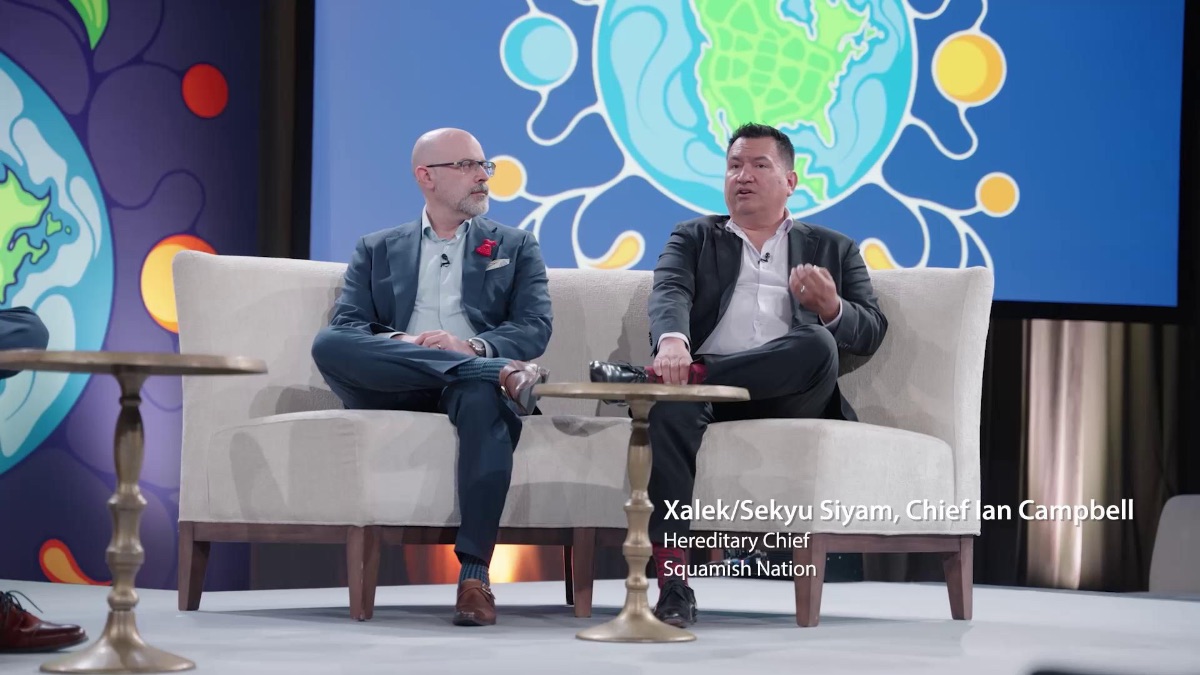
Chief Ian Campbell (right) with Woodfibre LNG’s CEO, Luke Schauerte
(Posted here 10 June 2026)
