Investors short-hand it as FID: the Final Investment Decision, in which investors decide if a multi-billion-dollar mega-project gets a final green light and goes ahead.
Now Canada and BC are awaiting vital FIDs on two LNG-for-export projects: One on the expansion of LNG Canada at Kitimat and one on the proposed Ksi Lisims LNG project with the Nisga’a Nation in northern BC.
For LNG Canada, the partners say the FID for Phase 2 expansion of the current plant could come by the end of the year.
We’ve seen unofficial estimates that the cost could be $30-33 billion — on top of the $40-43 billion for the plant and the Coastal GasLink pipeline that feeds it.
That $40-43 billion was hailed by the federal government as “largest single private sector investment in the history of the country.’
The Phase 2 expansion would increase the output at Kitimat to 28 million tonnes a year from 14 million. The world’s largest LNG plant is Sabine Pass, Louisiana, at 30 million tonnes a year.
CEO Wael Sawan of Shell (a 40% partner in LNG Canada) gives this outlook for FID: “It’s likely to be before the end of this year, is what we are targeting along with the joint venture partners.”
(The other partners are Petronas, 25%; PetroChina, 15%; Mitsubishi Corporation,15%; and Korea Gas Corporation, KOGAS, 5%.)
Signal that FID is looming
A most recent and clear signal that the FID is approaching: Taekwang, a Korean pipe-fitting specialist, signed in mid-August a US$6.27-million contract with Japan’s JGC to provide industrial fittings for LNG Canada Phase 2. Taekwang also supplied the first phase of LNG Canada.
JGC builds large-scale energy plants and infrastructure worldwide. It and US-based Fluor Corporation were the main engineering, procurement, and construction contractors for the current LNG Canada export terminal.
They received, in June, “limited notice to proceed” (LNTP) for Phase 2 expansion.
Pierre Bechelany, Fluor’s business-group president of energy solutions, said then: “The LNTP enables us to initiate early planning and move forward with key activities to support a proposed Phase 2 final investment decision by LNG Canada.”
LNTP allows for, before the FID, some engineering, site preparation, materiel procurement, and other work, and work on agreements with First Nations.
LNG Canada then announced, in July, an agreement with five neighbouring First Nations that allows them to invest up to $1 billion for a majority ownership stake in the proposed Phase 2 storage tank facility.
The federal government earlier reported that LNG Canada’s joint-venture participants had approved “hundreds of millions of dollars in incremental funding to help finalize critical work scopes to achieve a potential FID by the end of the year.”
Ottawa went on to say: “A Phase 2 investment could position Canada as a top-five global LNG exporting nation, supporting Canada’s energy superpower ambitions.”
The feds spoke of Phase 2 creating jobs and added: “Emissions for Phase 2 are projected to be 35 percent lower than those for the world’s best-performing LNG facilities and 60 percent lower than the global average.”
FID signs from Ksi Lisims
Several sources have said we should expect the FID on the Ksi Lisims LNG project before the end of this year, although early 2027 has also been suggested.
A prime signal of a coming FID was given when the PRGT pipeline on August 10 named BC-based Surerus Pipeline Inc. as a joint-venture contractor to build the 750-km line to feed natural gas to Ksi Lisims.
Surerus and its joint-venture partner (UK-based J. Murphy and Sons) have previously built portions of the Coastal GasLink pipeline in BC and are building the Eagle Mountain pipeline that will feed natural gas to the Woodfibre LNG project.
Before that signal came two other significant announcements: German energy trader SEFE signed on May 27 an agreement to take one million tonnes of LNG a year from Ksi Lisims. And another German buyer, Uniper, announced 12 days later that it had signed a letter of intent to take two million tonnes a year.
Earlier, France’s TotalEnergies, the world’s third-largest LNG player, signed up for two million tonnes a year (MTPA) and Shell for another two million tonnes.
In all, as Nelson Bennett reported on EnergyNow News: “That brings total offtake commitments to seven MTPA, which is 58% of the Ki Lisims’ annual nameplate production capacity. (Which will be 12 million tonnes a year.)
“One more agreement like this may be all that is needed for the joint venture partnership — Nisga’a, Western LNG and Rockies LNG — to go to the bank to secure financing for a $20-billion final investment decision.”
The latest estimate, from a federal government news release in July, is that the Ksi Lisims project is expected to cost $30 billion. But that figure does not include the PRGT pipeline, the office of Natural Resources Minister Tim Hodgson said. A preliminary estimate for PRGT is $10 billion.
Of recent interest — but ages short of any FID — come two brand-new LNG-for-export proposals involving First Nations:
- Wapusk LNG proposes to produce LNG in Saskatchewan and ship it by rail to an export terminal near Port Nelson MB, on Hudson Bay. Wapusk aims to have up to 90% First Nation ownership: https://bit.ly/4qqPR0e
- And Indigenous-led Kino Aski LNG project proposes to send Canadian LNG to Europe, from Quebec: https://bit.ly/4xtP817
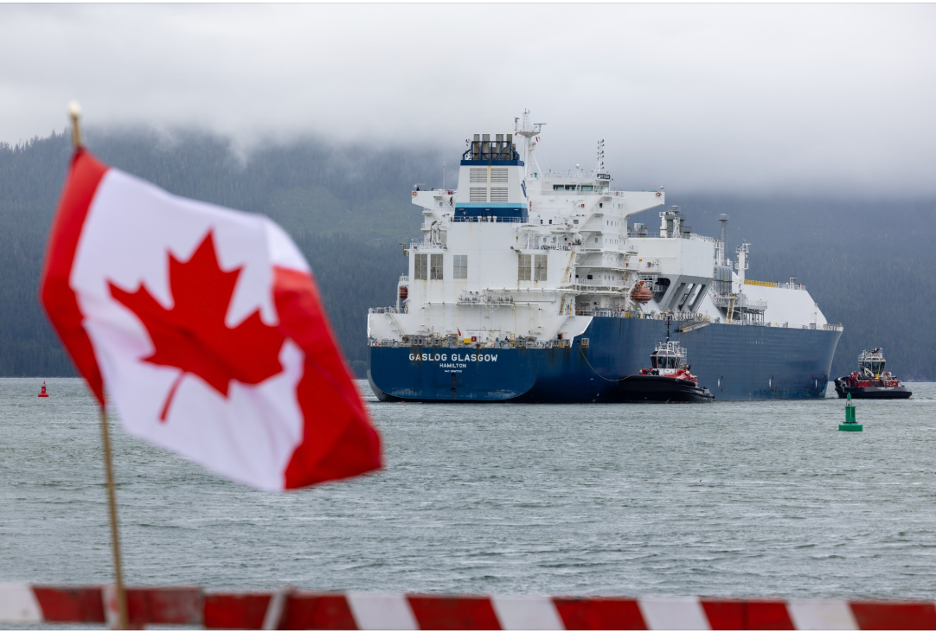
The first shipment from LNG Canada departed, above, on June 30, 2025, for South Korea. Cargo No. 100 left on June 18 this year. An unofficial count reports 124 shiploads now have been sent off.
(Posted here 20 August 2026)
