British Columbia’s original policy for new liquefied natural gas plants was clear: They must produce net-zero emissions by 2030.
So, for one thing, there was to be no burning some of their incoming natural gas to generate the electricity needed to operate their LNG plant.
Then reality struck home: There was simply no way that BC Hydro could provide enough clean power to run a new string of such “clean” LNG facilities.
And so, in 2025, the policy was rewritten: LNG proponents now need only to provide “a credible plan” to be “net-zero ready” by 2030.
“This framework,” said law firm Norton Rose Fulbright, “makes the province’s LNG policy consistent with targets established as part of its CleanBC ‘Roadmap to 2030′. . .
“The details of the new framework – including standards for emissions testing and what constitutes a ‘credible plan’ – have yet to be clarified, but proponents with projects currently in the environmental assessment stage, or those considering entering it, will face these new requirements.
“The province’s messaging suggests it will not be imposing additional requirements on existing LNG facilities, so changes for facilities with existing environmental assessment certificates are not expected.”
Thus LNG Canada, which certainly hopes eventually to be fully powered from BC Hydro, still burns some of its incoming gas to generate enough power.
The Haisla Nation’s Cedar LNG project, already under construction, is required only achieve net-zero by 2050. But the province and Haisla Nation have agreed to cooperate to work toward near-net-zero emissions by 2030.
And, even if not net-zero itself, the project could support broader decarbonization objectives, given that (as the BC Environmental Assessment Office recognized) the project “could have a positive impact on GHG emissions globally, if the importing countries were to use the natural gas as a replacement for coal in power production.”
Energy Minister Adrian Dix said the new requirement for LNG proposals simply means having an LNG terminal “ready” to be powered by grid electricity — if BC Hydro can provide enough electricity.
Which it couldn’t then, and can’t now.
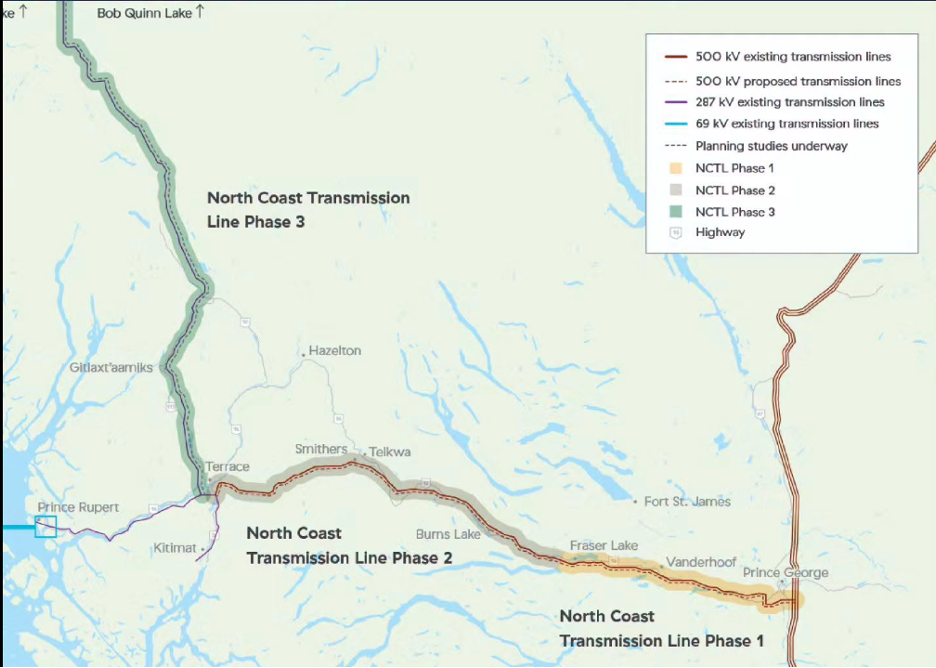
But there’s at least some light on the distant horizon, now that the first preliminary construction work has begun on Phase 1 of the North Coast Transmission Line (NCTL) and its expansion of BC Hydro power from Prince George to Terrace.
The new 500-kilovolt (kV) transmission line twins the current 500kV line, on which demand exceeds its capacity.
As Resource Works notes: “Electricity demand from mining, LNG and port projects has now outrun the existing 500-kV line between Prince George and Terrace, and the smaller stopgap capacity BC Hydro has been able to add is already effectively spoken for.
“You cannot run a modern industrial economy on a grid that is full. Phases 1 and 2 will add roughly 440 kilometres of new 500-kV transmission between Prince George and Terrace and more than double the power available on the North Coast.”
Phase 1, from Prince George to the Glenannan Substation near Fraser Lake, is expected to end by mid-2030. Phase 2 construction, from Glenannan Substation to the Skeena Substation in Terrace is planned to begin in 2027 and wrap up by winter 2032.
Further expansion phases have not yet been detailed.
The cost is estimated at around $6 billion for the first two phases. That’s double BC Hydro’s original estimate in 2023 of $3 billion.
The Canada Infrastructure Bank came up with a $139.5-million loan to BC Hydro to support pre-construction activities such as planning, engineering, fieldwork, procurements, consultation with First Nation communities, stakeholder engagements and improving site access.
Then on July 2, the federal government and BC signed a new “Cooperative Prosperity Agreement” under which Canada and BC have already committed $3.9 billion toward phases 1 and 2 of the NCTL project.
The new line, says the BC government, “will meet surging clean electricity demands from regional mining, ports, liquefied natural gas (LNG), and industrial electrification.”
The province went on to say:
- “The North Coast Transmission Line (NCTL) will create 9,700 direct full-time jobs once finished and employ as many as 1,400 workers at peak construction
- “NCTL is expected to contribute nearly $10 billion per year to B.C.’s economy and generate approximately $950 million annually in provincial and municipal revenue
- “It will help reduce B.C.’s economic reliance on the United States, as part of B.C.’s Look West strategy for jobs.”
A key part of the project is — or will be — First Nations participation. The BC government is open to 14 affected First Nations taking a 50/50 equity stake in the transmission line. BC hopes to come up with co-ownership agreements by the end of this year.
Says BC Hydro: “This model reflects our commitment to meaningful reconciliation and long-term partnership, ensuring First Nations communities share in the planning, development and decision-making process for NCTL, as well as sharing in the associated economic benefits.”
- Chief Leah Stump of the Nazko Nation: “Nazko has been engaged in this project from the very beginning and we are excited about the prospects of co-owning this transmission line with the other First Nations with whom we share a common history and shared territory. This project will create generational benefits for our people.”
- Chief Beverly Ketlo, Nadleh Whut’en First Nation: “We have completed our . . . review of the NCTL. We will continue to work with BC Hydro, BC and the BC Energy Regulator to ensure our concerns are addressed and accommodated in Phase 1 and Phase 2. Our partnership with B.C., BC Hydro and Canada are demonstrating First Nations must be involved in all major projects.”
- “Our involvement in the NCTL project shows that our people are not against projects in the national interest. First Nations are prepared to support major projects that align with our values and secure long-term benefits that we reinvest in our territories, benefiting all Canadians. All our conditions to build haven’t been addressed by the Crown. We expect these to be included in agreements finalized in the fall.”
Among projects looking forward to the new power supply is Ksi Lisims LNG, a $30-billion project planned by Western LNG of Texas and the Nisga’a Nation. Ksi Lisims has a Memorandum of Understanding with BC Hydro for up to 600 megawatts once the line is expanded.
And, as Resource Works adds: “Ottawa explicitly names the NCTL as the infrastructure enabling both Ksi Lisims and mining in the Golden Triangle. And there are more projects, and more jobs, that require a steady source of electricity outside of the LNG space, like copper, critical minerals and port expansions.”
(Posted here 17 September 2026)
