Ksi Lisims LNG, a proposed Indigenous-led floating facility in northwestern BC, is rapidly approaching a final investment decision (FID).
The proponents are the Nisga’a Nation (which owns the planned site for onshore components at Wil Milit in northwestern BC), Rockies LNG (a partnership of Western Canadian natural-gas producers) and Texas-based Western LNG (which has been working on floating LNG plants since 2015).
(Some gas producers recently left Rockies LNG to pursue individual supply deals with Western LNG for the Ksi Lisims project, including supplying natural gas to Ksi Lisims. Western LNG says this does not affect the prospects or progress for Ksi Lisims.)
The Ksi Lisims plant will produce 12 million tonnes of LNG a year. It will meet BC government requirements to be net-zero-ready, and the Nisga’a Nation promises that it will operate “in a manner consistent with the Nisga’a Nation’s commitment to stewardship of the land and its people.”
It already has some key agreements for purchase of its LNG: German energy trader SEFE signed on May 27 an agreement to take one million tonnes a year (MTPA). Another German buyer, Uniper, announced 12 days later that it had signed a letter of interest to take two million tonnes a year, and confirmed that on July 29 by signing an agreement to take that much LNG for up to 20 years.
Earlier, France’s TotalEnergies, the world’s third-largest LNG player, signed up for two million tonnes a year and Shell for another two million tonnes.
In all, as Nelson Bennett reported on EnergyNowNews: “That brings total offtake commitments to seven MTPA, which is 58% of the Ki Lisims’ annual nameplate production capacity.
“One more agreement like this may be all that is needed for the joint venture partnership — Nisga’a, Western LNG and Rockies LNG — to go to the bank to secure financing for a $20-billion final investment decision.”
As well, Ksi Lisims LNG now has benefit agreements with the Gitxaala, Lax Kw’alaams, and Metlakatla First Nations. These agreements resulted in the withdrawal of their earlier legal challenges to the project’s environmental assessments. More recently, the Gitga’at First Nation signed a benefits agreement too. And an agreement with Kitselas Nation was signed last year.
Eva Clayton, president of the Nisga’a Nation (and chair of the First Nations Natural Gas Alliance) says “Ksi Lisims LNG is a once-in-a-generation opportunity for our people to build prosperity and economic independence.”
And: “We have always envisioned the Ksi Lisims LNG project as economically important for the entirety of northwest B.C., and we are pleased to see this vision materializing.”
The BC government notes that BC Hydro has signed a memorandum of understanding (MOU) with Ksi Lisims LNG, “a key step toward securing a major customer for the planned North Coast Transmission Line.”
(That power line is a $6-billion BC Hydro project designed to double clean-electricity capacity in northwestern BC. It will power resource developments such as Ksi Lisims LNG, other LNG development, mining, and communities. Construction is about to start.)
The government adds: “The MOU provides clarity on how and when BC Hydro will deliver as much as 600 megawatts of clean electricity to the proposed floating LNG facility on Nisga’a Treaty Lands, enabling one of the largest industrial projects in the region.
“The MOU helps Ksi Lisims LNG move toward a final investment decision and reaffirms the need for the North Coast Transmission Line. Both these projects have been identified as nationally significant by the federal government.”
The government went on to say: “Ksi Lisims LNG is expected to attract nearly $30 billion in investment, create thousands of skilled careers and strengthen Canada’s position as a global LNG exporter.”
The project anticipates peak construction employment of roughly 800 and about 150 to 250 permanent operating positions. It has the potential to add $24 billion to Canada’s economy over 30 years.
There have been questions about the practicality and cost of shipping LNG from Ksi Lisims to Germany, but Ksi Lisims itself has not spoken of such shipments. Instead, the German buyers are more likely to trade the cargoes with Asian and Pacific buyers.
Thus, for example, a Japanese buyer of an LNG cargo from the Middle East could do a “cargo swap” and have it go to Germany instead, in exchange for an LNG shipment to Japan from BC.
The federal government has hailed Ksi Lisims LNG: “As an Indigenous-led major project, Ksi Lisims LNG is an example of Indigenous leadership in the energy and natural resources sector, highlighting the positive benefits of Indigenous groups as project leaders in major projects. This project offers opportunities for Indigenous groups, while contributing to economic growth.”
The feds went on to list these points:
- Job creation: Predicted to create over a thousand skilled jobs, both during construction and on a permanent basis.
- Major investments: Ksi Lisims LNG, PRGT, and NVRTL (the Nass Valley Regional Transmission Line to power Ksi Lisims LNG) together are expected to attract $30+ billion in investment.
- Economic growth: During its operations, the LNG facility is predicted to contribute more than $15 billion in GDP to the Canadian economy over 30 years.
- Large-scale LNG facility: Will become Canada’s second-largest LNG facility.
- Net-zero emissions: Predicted to be net-zero emissions when connected to the BC Hydro power grid.
And this month Ottawa and BC signed the new Canada-British Columbia Cooperative Prosperity Agreement, “which will further accelerate the construction of major energy and trade corridors, including Ksi Lisims LNG.”
On Ksi Lisims LNG, the feds added: “The federal government will work with proponents, communities, and First Nations to accelerate the permitting, financing, and construction of this project to boost LNG supply for Canadians and our allies.”
(The Ottawa-BC agreement also sees as “priority projects” LNG Canada Phase 2 expansion, the Haisla Nation’s Cedar LNG project, and Woodfibre LNG.)
An essential part of the Ksi Lisims project is the $10-billion PRGT natural-gas pipeline that will feed the Ksi Lisims plant. The line was originally intended to supply the proposed Pacific NorthWest LNG export facility on Lelu Island near Prince Rupert, but that project was shelved in 2017. Now, with new routing, the pipeline will feed Ksi Lisims LNG instead.
At last report, PRGT was working on secondary permitting, and on planning for construction.
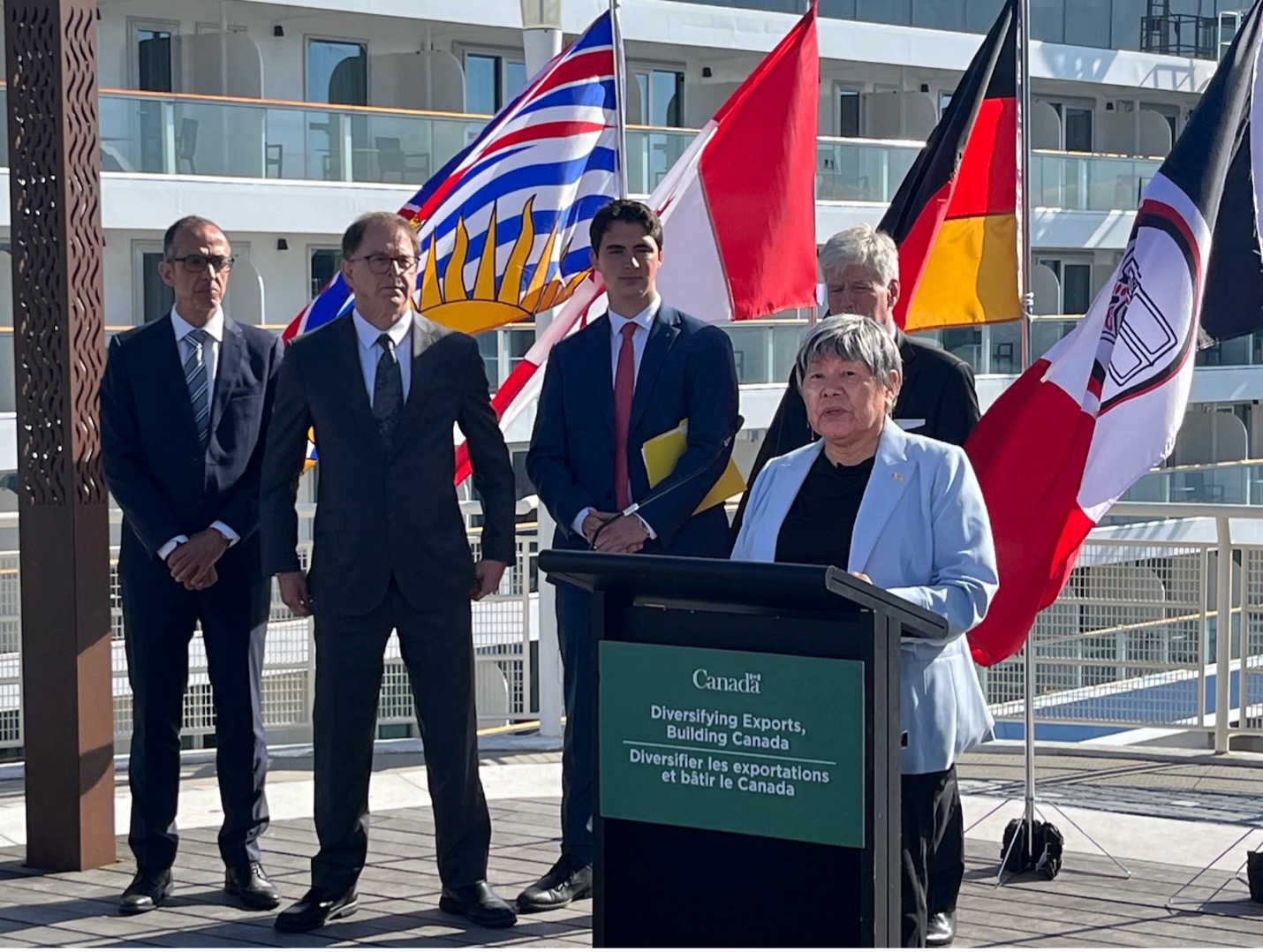
Nisga’a Nation President Eva Clayton speaking on German offtake agreement. Nelson Bennett photo
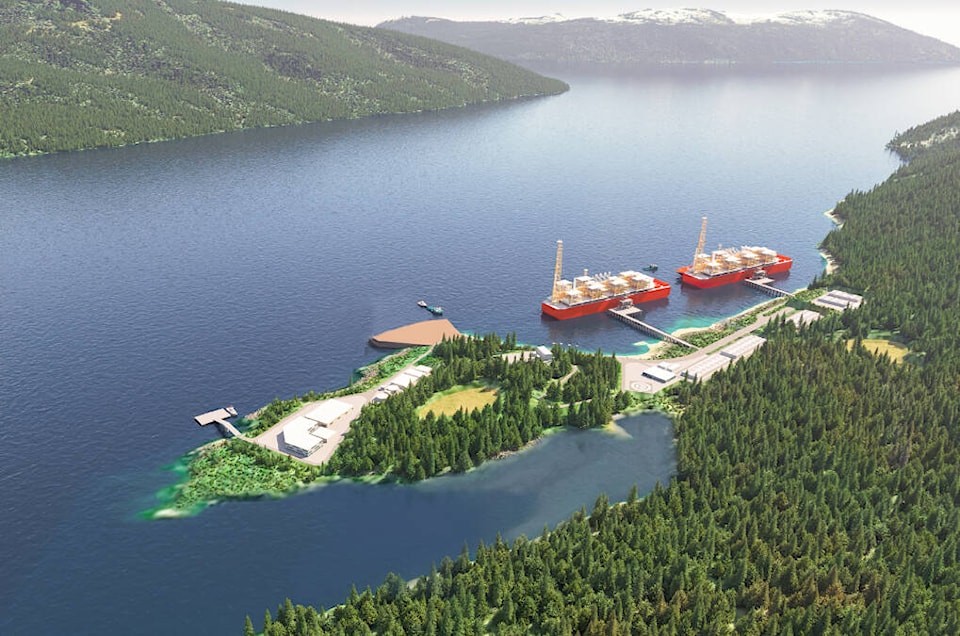
Artist’s concept of Ksi Lisims two-unit floating plant
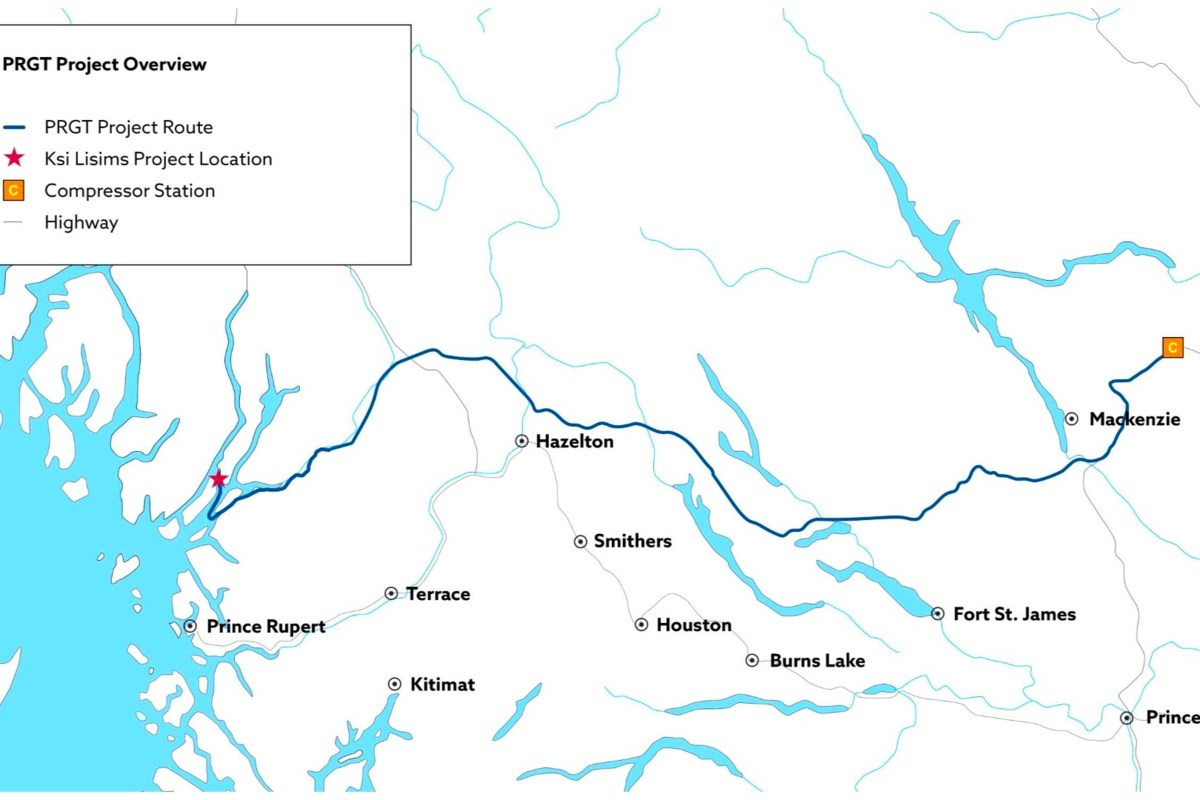
Route of the PRGT pipeline that will feed natural gas to Ksi Lisims LNG
(Posted here 22 July 2026 and updated 29 July 2026)
